Domain · Reservoir Simulation
From raw data to a model you can defend
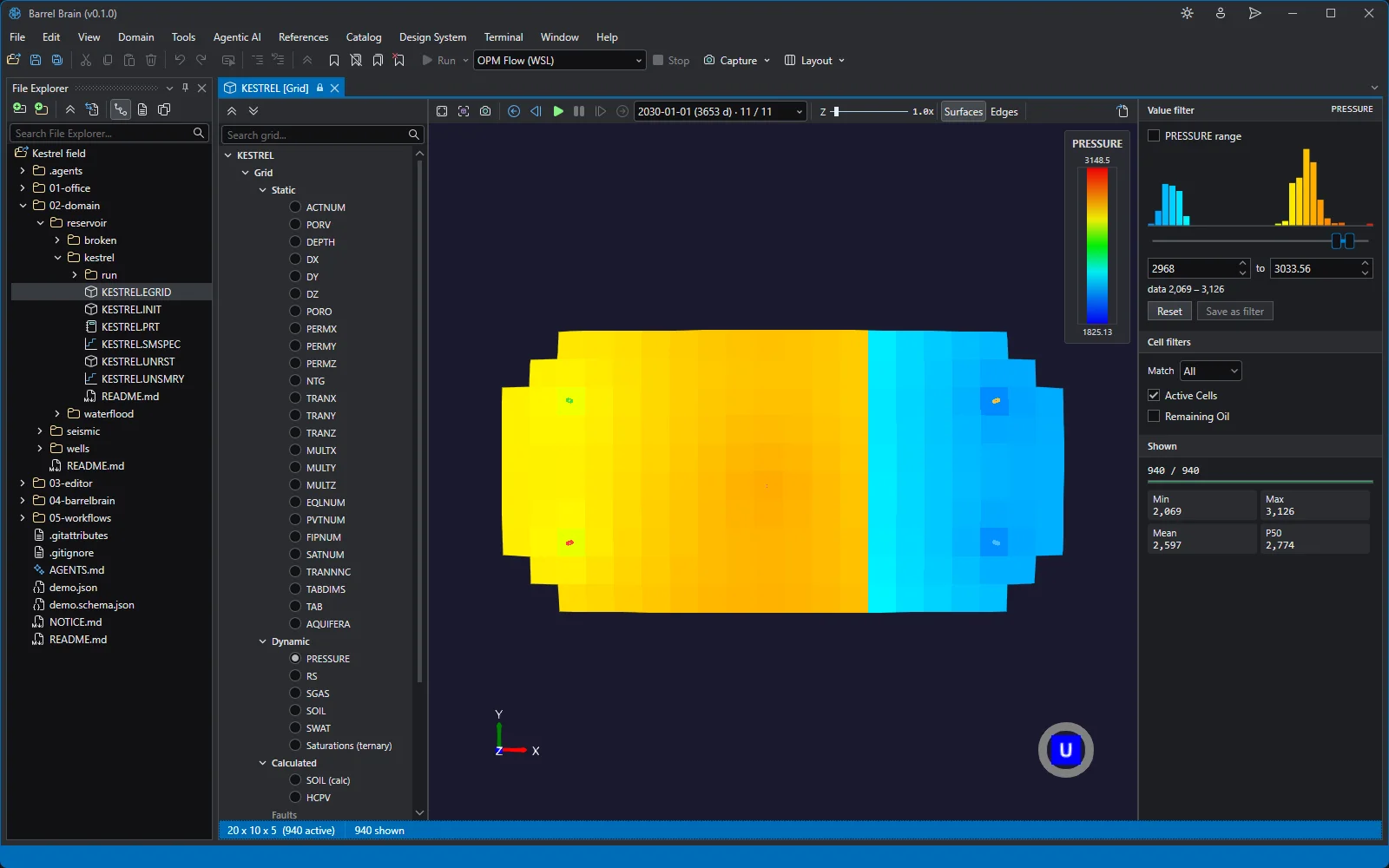
The agent reads the raw data, builds the grid, writes the deck, runs the cases and pulls the results together. You check the model in 3D, the forecast against history, and every line it changed in the deck.
Briefs it takes
Give it the job, the way you'd brief a colleague
“The raw data for the field is in this folder. Build me a reservoir model, run a sensitivity study on the main uncertainties, and write me a short report.”
grid builder · Eclipse deck · .STUDY sampling · simulator runs
“These are the PVT lab reports. Tune an equation of state to the CCE and DLE data, put the PVT tables into the deck, and tell me where the match is weakest.”
EoS regression · lab-test simulation · black-oil export to Eclipse
“Interpret the latest buildup tests. Flag the wells that see a boundary, and update permeability and skin in the model where the tests disagree with it.”
PTA models · Bourdet derivative · regression · deck edits
Verification
Viewers built for checking the work
Everything the agent does leaves a file in the project folder, and every file opens in a viewer meant for inspection. You don't have to take the agent's summary on trust.
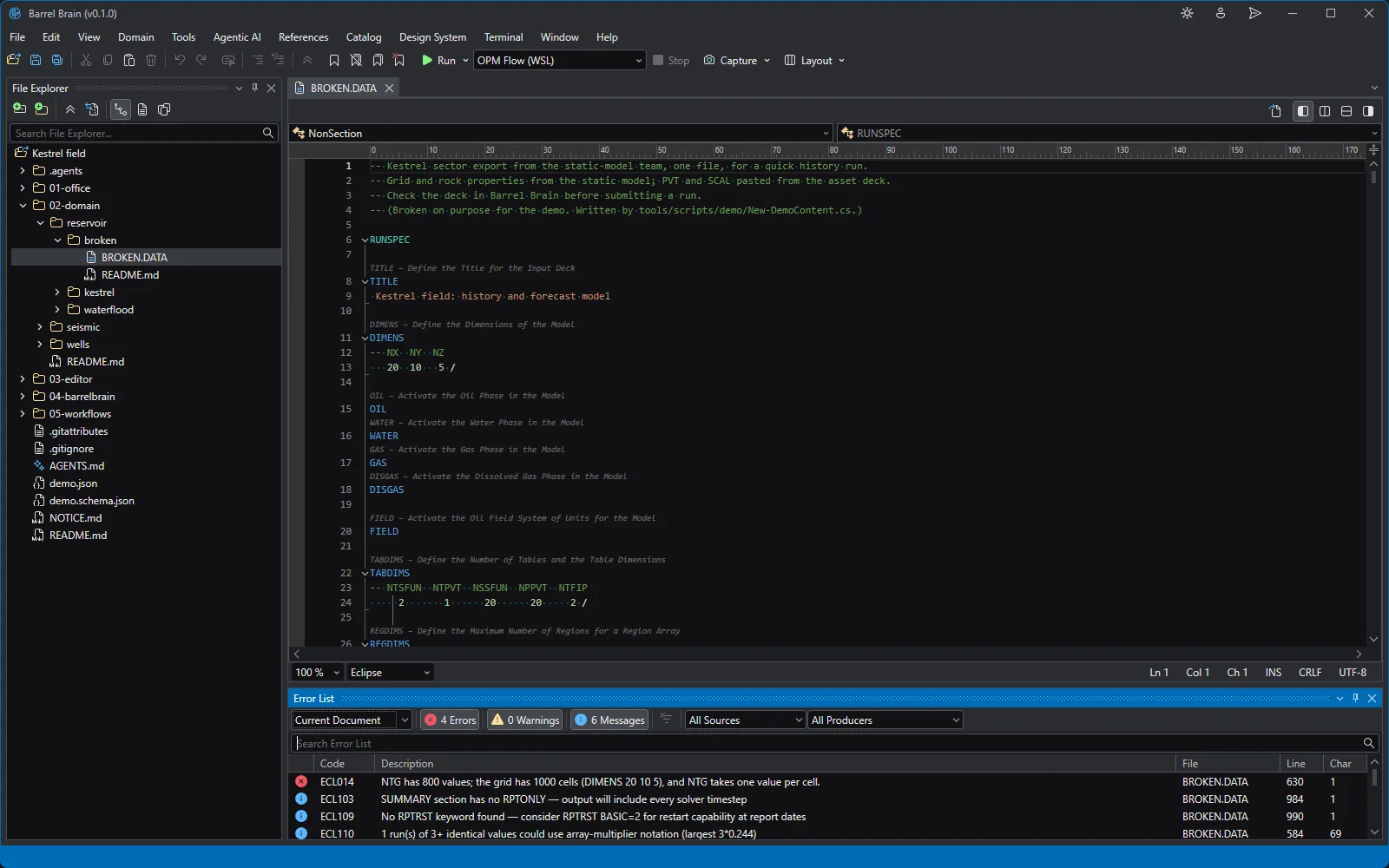
Deck
Will it run?
Problems are listed before a run is spent: a table with no closing slash, or 1000 values for a 300-cell grid.
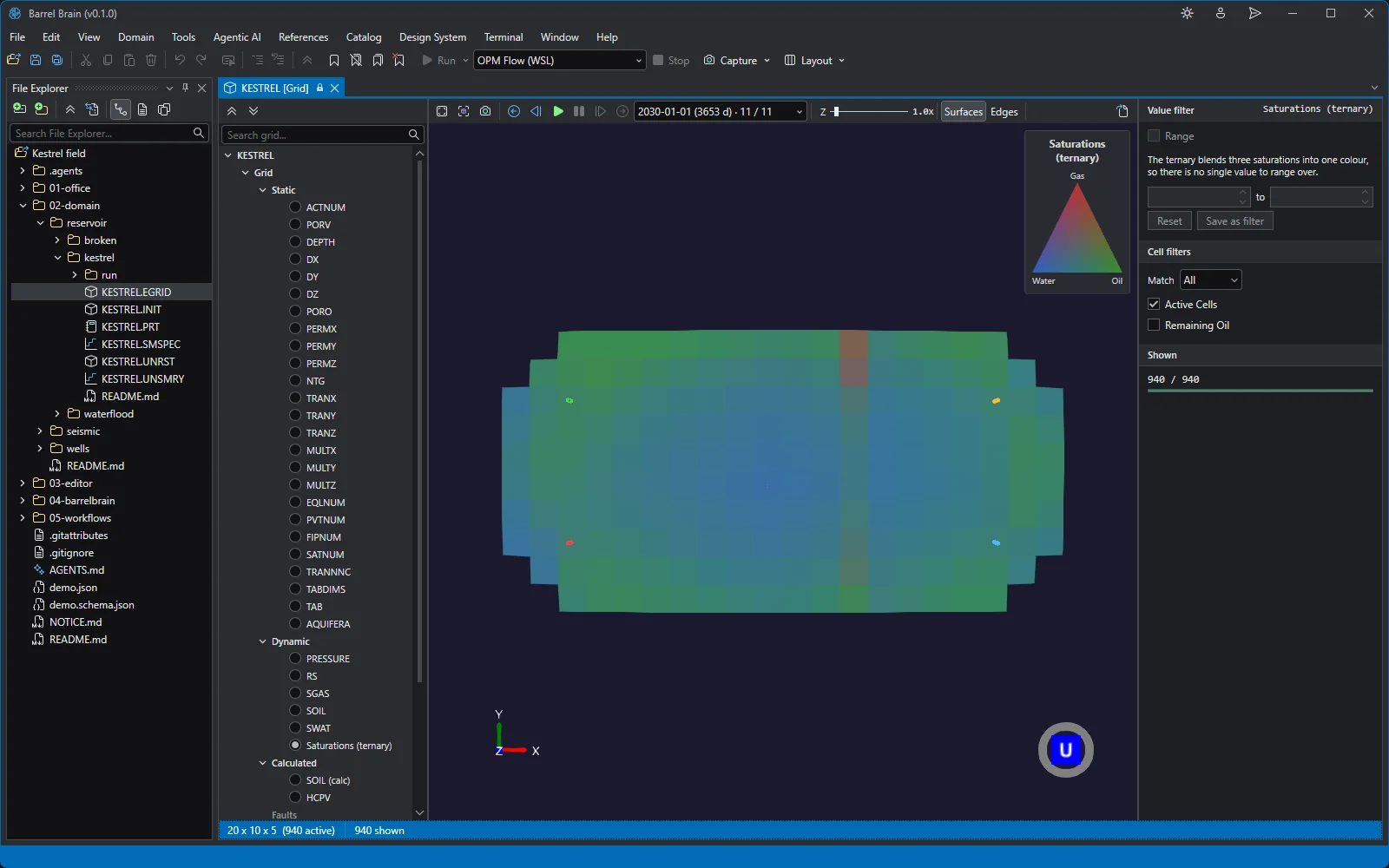
3D grid
Does the model look right?
Static and dynamic properties, cell by cell, at any report step.
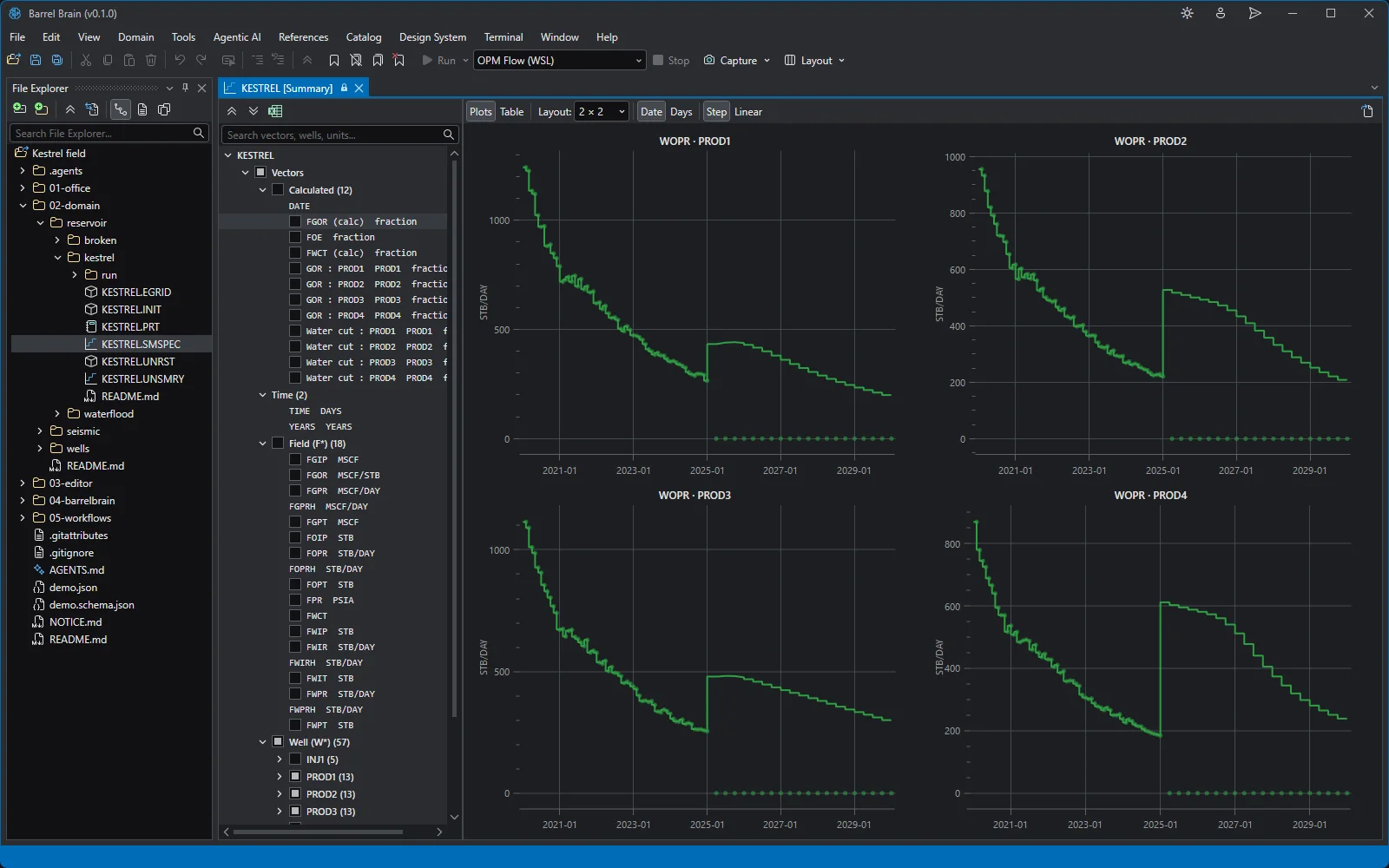
Summary plots
Does it match history?
Field, group and well vectors against observed data.
Studies
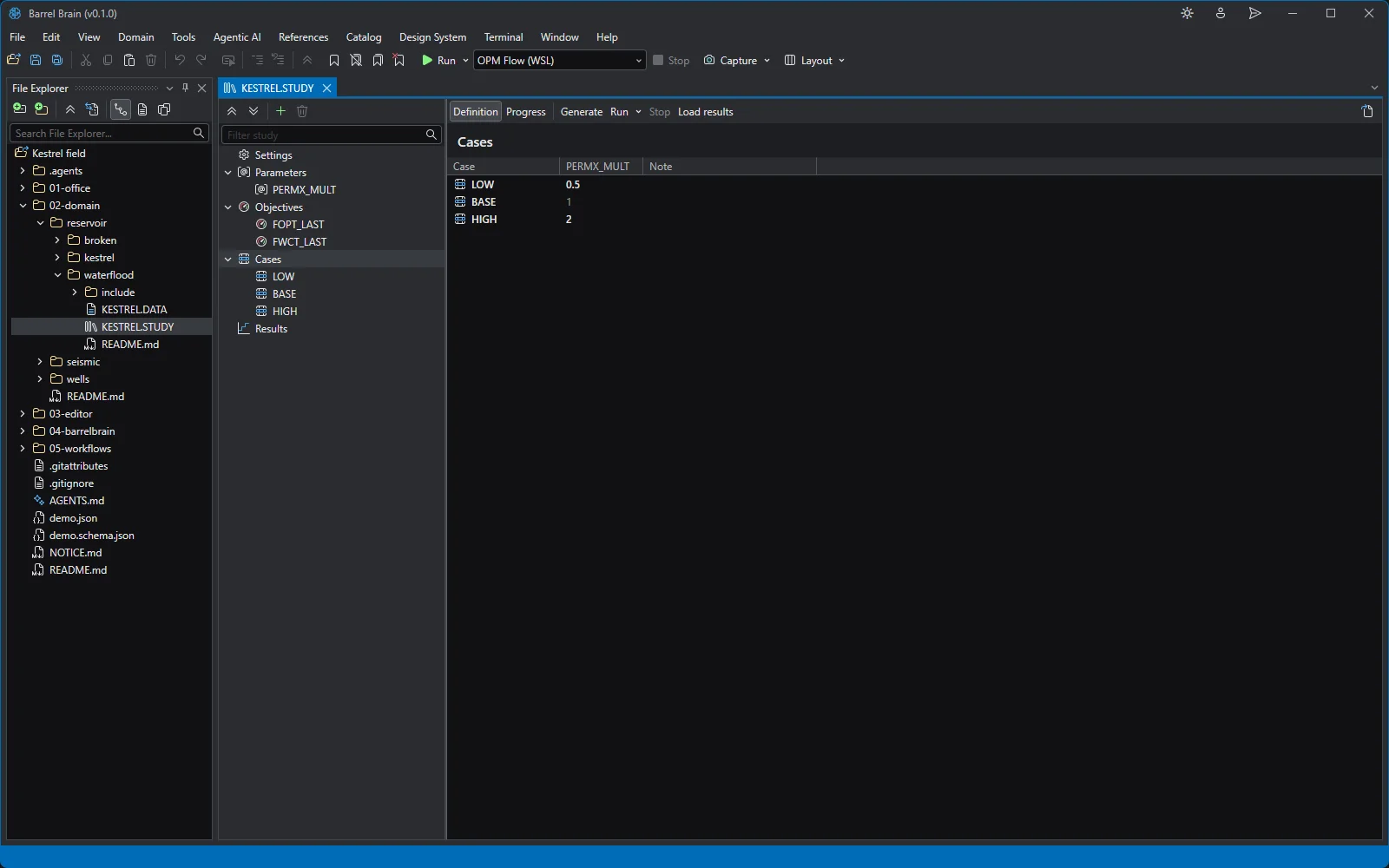
Which uncertainties move recovery?
One .STUDY file: parameters, distributions, sampling (Latin hypercube, full factorial, one at a time), runs and objectives.
Changes
What did the agent change?
A side-by-side diff of every file it edited.
Run logs, logs and seismic
Are the inputs what we think?
The simulator's run log, LAS curves, SEG-Y traces, and INIT and restart arrays as tables.
Under the deck
Real engineering, not made-up maths
The agent doesn't invent its own correlations. It calls documented, tested, unit-aware libraries, so a PVT table or a material balance traces to a named method.
- Reservoir simulation
- Read and write Eclipse decks. Grids, initial and restart properties, summary vectors, RFT. Build a grid from raw inputs.
- Black-oil PVT
- Bubble point, Rs, Bo, z-factor, viscosity, compressibility. CO₂ properties from Span–Wagner. Consistency checks on PVT tables.
- Equation of state
- Peng–Robinson and SRK with volume shift. Simulated CCE, DLE, CVD, separator and swelling tests, regression to lab data, and black-oil tables exported to an Eclipse deck.
- Rock and SCAL
- Corey, LET, Honarpour and Ibrahim–Koederitz relative permeability, Stone I and II, capillary pressure from Brooks–Corey, van Genuchten and the Leverett J-function.
- Material balance
- Havlena–Odeh for oil, p/z for gas, drive indices, and Schilthuis, van Everdingen–Hurst and Fetkovich aquifers.
- Pressure transient
- Buildup, falloff, interference and multi-rate tests, eight boundary types, Bourdet derivative, regression to field data.
- Uncertainty
- Monte Carlo with correlated inputs, P10/P50/P90, tornado charts and convergence checks.
Grounding
1,000+
pages of Eclipse keyword manual. The agent reads the page before it writes the keyword.
Worked examples
44
complete decks with notes: CO₂ and H₂ storage, thermal steam, polymer flood, compositional, local grid refinement, multi-segment wells, network balancing.
Your simulators
Eclipse, OPM Flow, any command line
Runs start from a launch profile. The agent queues them, puts a watcher on each, and reads the results when they finish.
Fair questions
What engineers and IT ask about the models
“Can it handle our real models? They're big and messy.”
It's built on the formats, not on toy examples. Decks follow their includes, and big results are read a step or a trace at a time.
The deck parser follows INCLUDE files and reports problems before a run is spent. Restart files are read one report step at a time, and SEG-Y is streamed, never loaded whole. It is built for real models, not samples.
“AI makes things up. I can't put its numbers in a reserves report.”
The agent doesn't do the engineering maths itself. It calls tested libraries, and every number comes from a file you can open.
The script or query that produced it stays in the project, and the session records exactly what ran. The engineer still signs the report; Barrel Brain makes the work behind it inspectable.
“Our subsurface data can't leave the building.”
The data and the work stay on the workstation. Only the model call goes out today, to a provider you choose.
The project folder, the simulator runs, the libraries and the viewers are all local, and there's no cloud database. On-premise models are on the roadmap next, and an air-gapped workstation after that.